Top 6 Tools Used in Remote Infrastructure Management
Guide on Monitoring Tool's Features, Price, and Where to Use

Overview of Remote Infrastructure Monitoring Tools
Businesses need to manage both cloud and on-site infrastructure effectively to maintain zero downtime for environments.
As IT environments switch to cloud systems, managed remote infrastructure services make it easier for businesses to focus on what matters to them most.
In this article, we will see the top remote infrastructure monitoring tools that help teams observe systems, manage resources, maintain performance, and keep infrastructure running smoothly across different environments.
Introduction to IT Infrastructure Monitoring Tools for MSP
Managing cloud operations manually can become difficult as cloud systems grow larger and more complex.
Today’s environments often include a mix of on-premise systems, cloud workloads, virtual machines, containers, SaaS applications, and remote locations.
Since a single platform cannot cover all the needs, choosing the right monitoring tools for each of your specific needs can make management much easier.
This guide explores the top 6 IT infrastructure monitoring tools that help MSPs and IT teams gain real-time visibility, simplify deployment, manage costs effectively, and identify issues before they affect users.
Benefits of Infrastructure Management Tools
With so many services and resources to handle, infrastructure management and remote monitoring tools make the process easier. They help through task automation, scalability improvement, and giving better visibility into how resources are being used. As a result of this, businesses stay flexible and control costs.
Using RMM tools for IT architecture maintenance helps reduce human workload and maintenance expenses. However, businesses still need a skilled IT team that can handle these tools skillfully. This ensures proper setup, management, and maintenance for better results.
How we evaluated the tools for MSP
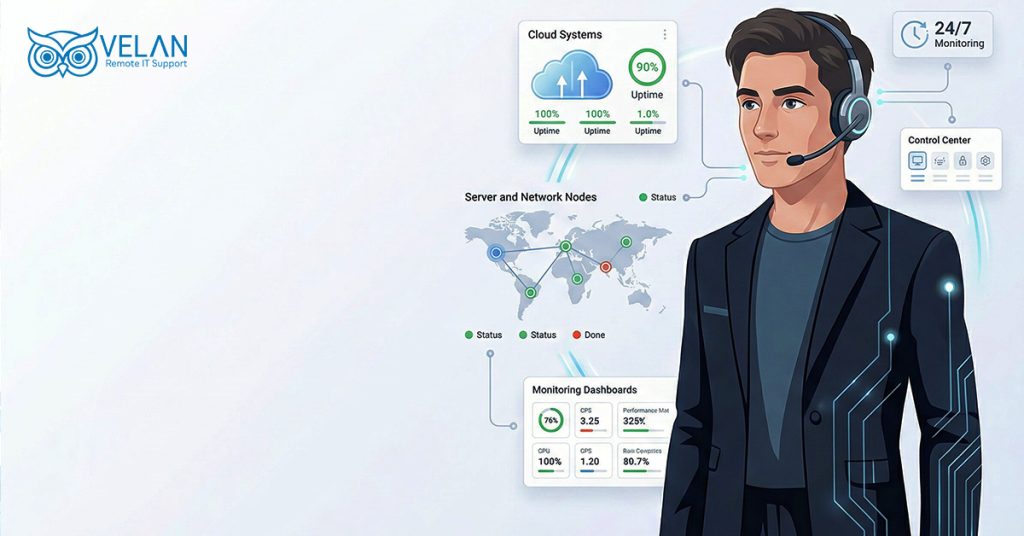
Task automation: It should assist in automating routine activities like monitoring, provisioning, and scaling.
Cost control: It should track resources and prevent unused assets from adding unnecessary expenses.
Performance improvement: It should enable continuous system monitoring and send alerts to resolve issues quickly.
Security strengthening: It should support features like access control and compliance monitoring to protect data and systems.
Supports Growth: It should make infrastructure scaling easier.
Best Remote Infrastructure Monitoring Tools
1. SolarWinds RMM (SolarWinds Remote Monitoring and Management)
This cloud-based RMM platform is used to view and watch client endpoints and networks from a central dashboard. It helps in early detection of issues and fixes them before they impact users. The platform also supports automation to efficiently manage multiple client environments.
Capabilities
· Manage endpoints like desktops and servers across Windows, Mac, and Linux.
· Automation of OS patching, disk space cleanup, and software installations.
· Has in-built EDR (endpoint detection and response)
· Provides cloud-based backup and restoration options
· Enables direct access to client resources for troubleshooting
2. Datadog
Datadog is a cloud-based monitoring and analytics platform used to manage IT environments. It helps teams monitor cloud systems in real time. The platform provides better visibility into system performance and resource usage. This helps organizations track issues and maintain smooth operations.
Capabilities
· Provides centralized visibility for cloud infrastructure, applications, and system logs.
· Use AI insights to detect unusual activity and identify the root cause of issues.
· Offers customizable dashboards with instant data analysis
· Supports integration with AWS, Azure, and Google Cloud Platforms.
· Supports DevOps tools integration.
· Features a scalable design that can adapt to infrastructure needs.
3. New Relic
New Relic provides complete observability that helps businesses in application monitoring for performance. Infrastructure and network services can also be tracked using the platform. It supports efficient monitoring and management of cloud environments.
Capabilities
· Real-time performance tracking using golden metrics (transaction response time, application throughput, and error rates) and apdex scores.
· Customizable dashboards for data visualization
· Integrated APM tools for elaborate application monitoring
· Intelligent monitoring tracks AI/ML models like chatbots and virtual assistants. It checks their speed, costs, and bias possibilities.
4. Dynatrace
Dynatrace is like a super protector for your software and cloud systems. It watches several resources simultaneously to keep your web apps, server, VMs, containers, etc., running fast.
It has a built-in AI assistant named Davis that spots tech problems instantly and tells you exactly how to solve them.
Capabilities
· The Davis AI brain finds exact root causes of system glitches.
· Comprehensive monitoring across cloud environments, servers, applications, and user experiences.
· Session Replay feature to recreate user screens to show exact errors.
· Built-in security blocks digital attacks and catches software errors.
5. ManageEngine OpManager
It is a remote network and IT infrastructure monitoring tool used to trace the health and availability of IT systems. Performance monitoring features help organizations keep track of networks, servers, virtual machines, and other connected devices.
Capabilities
· Monitors switches, firewalls, routers, servers, storage devices, and VMs
· Provides live performance monitoring and issue alerts.
· Supports automatic device discovery and network mapping.
· Helps identify and troubleshoot network problems effortlessly.
· Supports distributed and remote infrastructure monitoring from a centralized dashboard.
6. Nagios XI
Nagios XI is the commercial version of the Nagios monitoring platform. Comes with an enhanced interface, setup tools, support, and enterprise features.
It combines flexibility with easier management. Does not require maintaining the open-source version. Its large plugin ecosystem supports extensive customization, making it a popular choice for advanced monitoring requirements.
Capabilities
· Single platform for full infrastructure monitoring
· Large plugin support for broader system coverage.
· Instantaneously detects issues and sends alerts.
· Offers an easy-to-use view with reports and performance insights.
· Can be tailored and scaled as your IT environment grows.
Comparison of Remote Infrastructure Monitoring software
| Tool | Best For | Starting Price |
| SolarWinds RMM | Managed service providers (MSPs) and remote IT management | Custom pricing |
| Datadog | Cloud-native and DevOps teams | Starts at approximately $15 per host/month |
| New Relic | Teams requiring full-stack observability and cloud monitoring | Free tier available; paid plans start around $0.35 per GB |
| Dynatrace | Large enterprises needing AI-driven application and infrastructure monitoring | Starts at approximately $21 per 8 GB host/month |
| ManageEngine OpManager | Network and IT infrastructure monitoring for SMBs and enterprises | Starts at approximately $245 annually |
| Nagios XI | Linux-focused teams requiring customizable infrastructure monitoring | Starts at approximately $2,495 per 100 nodes |
Pricing may vary based on features, deployment options, and vendor updates (Information based on online resources)
How to Choose the Right Infrastructure Monitoring Software?
Selecting the perfect suite depends on a few factors. Your environment, team capability, and budget are significant among them. Answering the following questions can help narrow down the best option quickly.
1. What are you going to monitor?
Network environments: If you want to track n/w components like routers and switches, then network monitoring tools are more suitable.
Application environments: If your monitoring needs are for cloud apps and their performance, then full-stack observability tools offer deeper visibility.
2. How many environments are you managing?
Multiple sites: Cloud-based platforms with centralized dashboards work best for distributed/remote environments.
Single location: On-premise tools may be better. You get full control over infrastructure.
3. Do you have the technical expertise?
Open-source tools: They are cost-effective, but require strong tech skills and continuous management.
Commercial tools: Easier to deploy and maintain. Saves time and operational effort in general.
Conclusion
IT infrastructure monitoring has become more specialized today because different teams have different needs. Network teams, MSPs, DevOps, and enterprise admin teams all require different tools and approaches to manage their systems effectively. Each tool serves a specific function depending on the resources and workloads in use.
For organizations seeking reliable execution beyond tools, Velan strengthens remote IT support by providing expert-managed services that ensure smooth monitoring, faster issue resolution, and reduced operational burden.
Our strengths
- ISO 9001, ISO 27001 Certifications for quality processes and data security
- 19+ years of industry experience
- Global service
- Certified engineers
- Flexible hiring models
Get customized and affordable remote IT services in your timezone | 24/7 Help Desk Support.
Know More About the Infrastructure Monitoring Tool
The installation and configuration of cloud monitoring software is quite easy and requires less manual maintenance. The tools are reliable and update themselves automatically. Teams can monitor multiple locations from one dashboard.
Managed service providers can monitor the entire client environment. They support everything from automated ticketing to reporting, which improves response times and reduces manual work. This helps reliable remote IT service providers like Velan deliver better service and quality solutions to their clients.
Cloud-based monitoring is easier to deploy and works best for most businesses. Also, it can scale quickly. On-premises tools are useful in some rare cases where you need strict and full control over systems.
These tools track key IT components like networks, servers, storage, cloud systems, and applications. They collect performance data using AI agents and APIs to help teams detect problems early and keep systems running smoothly.
Categories
- Reports 01
- Azure 02
- AWS 04
- Remote IT Support 03
- Cloud Security 03
- Cloud Services 04
- Managed IT Services 012