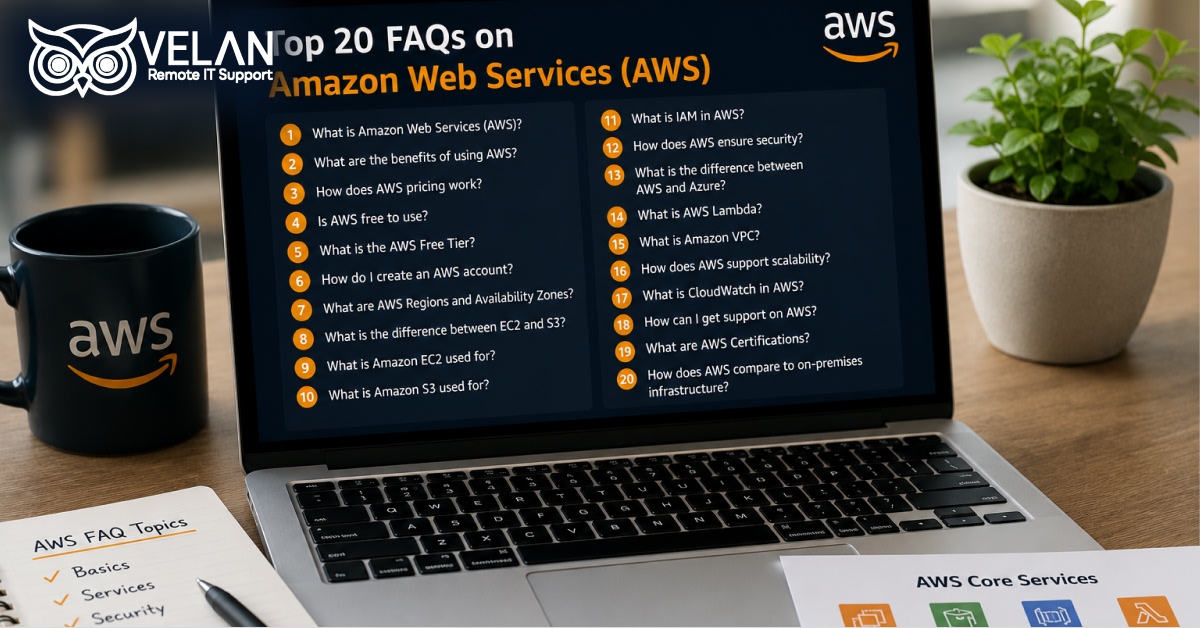
Top 20 FAQs on Amazon Web Services (AWS)
People Asked FAQs Associated With AWS Services
Introduction
AWS offers a complete portfolio of cloud services and tools that help organizations from building and deploying to managing and scaling applications efficiently. Amazon’s cloud platform solutions encompass a wide range of services from computing and storage to networking, security, analytics, and artificial intelligence. With the pay-as-you-go pricing model, businesses can access enterprise-grade cloud technologies without making much upfront investment.
In this article, we will see answers to some frequently asked questions about AWS solutions and how they can be used for your business to improve performance.
Industry-leading, experienced AWS cloud consulting companies offer compute, storage, database, networking & content delivery, security & identity, analytics, DevOps, migration & modernization services, and IoT solutions.
The most widely used AWS services across businesses are Amazon EC2, Amazon S3, Amazon RDS, Amazon VPC, AWS Lambda, Amazon CloudFront, Amazon CloudWatch, Amazon SageMaker, and Amazon Bedrock. Together, these services provide the foundation for hosting applications, storing data, ensuring security, and enabling analytics.
AWS offers several services and a pay-as-you-go pricing model that helps run a highly secure cloud infrastructure without high upfront costs for purchasing. This is one of the important reasons why many enterprises, including startups, choose AWS to implement a cloud environment for their business.
AWS’s cloud-native service called Amazon QuickSight was created specially for business intelligence. With its generative AI features, organizations can create interactive dashboards, generate paginated reports, and analyze data using natural language.
The SPICE memory engine for quick query performance and native interaction with AWS data services like Amazon Redshift, Amazon S3, Amazon Athena, and other third-party data sources are important advantages.
Amazon EC2 provides broader options to choose your instance types and sizes that can be scaled with workload requirements. It offers extensive control over your workloads like operating systems, networking, storage, and security configurations.
EC2 offers instance families like general-purpose and compute/memory/storage optimized options. They support different applications and performance needs.
AWS Elastic Disaster Recovery (AWS DRS) is used as a strong enterprise resilience strategy. It offers affordable storage, minimal compute, and point-in-time recovery features. Downtime and data loss can be minimized with fast, reliable recovery of on-premises and cloud-based applications.
AWS offers several other services for this purpose. AWS Backup tool unifies backup administration across all AWS resources. Amazon EBS Snapshots protect EC2 workloads, Amazon RDS provides automated database backups, and Amazon S3 Glacier supports long-term archival.
Startup businesses need scalability and flexibility as their operations grow faster. They begin with cost-efficient AWS services like Amazon EC2, Amazon S3, Amazon RDS, AWS Lambda, Amazon CloudFront, and Amazon Route 53, and then slowly adopt other services as required.
Small businesses reduce expenses for building IT infrastructure with cloud computing compared to on-premises servers. When running on AWS, businesses can save up to 31% compared to those using locally hosted infrastructure. You just have to pay for the resources you use, as AWS offers pay-as-you-go. To maximize these savings and optimize cloud performance, businesses often rely on cloud support services for modern enterprises.
Creating a good AWS migration project plan is the primary strategy. Pre-migration testing with real-world traffic simulations in the new environment helps catch issues early. This helps confirm cloud migration without downtime. Moving traffic and workload to the new cloud system through phased migration and continuous performance monitoring allows you to achieve a more successful migration.
On the technical side:
Utilize Rehosting (“lift and shift”) and asynchronous data replication.
Pre-sync your data in the background
Continuously update changes
Do a final cutover during off-peak hours
Amazon GuardDuty detects safety issues like unusual API calls, potentially unauthorized deployments, and communication with malicious IP addresses. The tool works without needing any security software, agents, or hardware to be deployed. It analyzes various data sources such as VPC flow logs, CloudTrail event logs, and DNS logs.
In short, GuardDuty monitors your AWS accounts, workloads, and data for malicious or unauthorized activity to help secure your cloud.
Amazon Elastic Load Balancing (ELB) is a managed AWS service that routes incoming user traffic across multiple application resources, including EC2 instances, containers, IP-based targets, and Lambda functions. Distributing workloads across multiple Availability Zones helps organizations handle traffic spikes while maintaining high availability and improving performance.
AWS Pricing Calculator is a free tool to generate a cost estimate for your chosen AWS services based on your use cases. It is the official web-based service that allows you to shape your architectural solutions before building them. You can explore different price points and evaluate different contract commitments and payment options to find a cost-saving option for your business.
AWS accelerates software development using AI-driven coding (Amazon Q Developer) and unified collaboration (Amazon CodeCatalyst). It automates testing and deployment (AWS CodePipeline and AWS CodeBuild), delivering a faster SDLC. Also, serverless compute (AWS Lambda) eliminates infrastructure management, allowing developers to speed up high-quality software releases.
Amazon CloudWatch is the core management and governance tool for monitoring in real-time. It automatically collects metrics, logs, and events from AWS resources. Also, developers get full visibility into application health.
Users can set automated alarms to proactively detect performance anomalies and trigger auto-scaling events to maintain system uptime.
Retailers may immediately identify suspicious activity by using the Amazon Fraud Detector tool from AWS services. Using machine learning, it analyzes activities such as new account registrations, guest purchases, and promo code usage in real time. It has the capability to identify risky transactions within milliseconds. This helps prevent fraud in retail businesses.
AWS provides a range of tools and services to reduce risks during cloud migration. AWS IAM Access Analyzer and AWS Secrets Manager for secure access, AWS KMS encryption for data protection, and Amazon Macie helps identify sensitive data such as PII. Amazon GuardDuty and AWS Security Hub continuously monitor for suspicious activity, misconfigurations, and security vulnerabilities.
The AWS services used for website hosting depend on the type of website, such as a static portfolio site or a dynamic e-commerce platform. AWS Amplify Hosting provides fully managed hosting for modern web applications. Amazon S3 can host and store website files, while Amazon EC2 offers scalable cloud servers to run web applications.
Building a migration roadmap helps ensure a smooth and organized cloud transition. Start by identifying workloads, dependencies, and business priorities. Define migration phases, timelines, milestones, and ownership for each task. Include risk mitigation plans, then strategically organize workloads to minimize disruption and maintain business continuity throughout the migration process. A successful roadmap starts with understanding the right AWS migration strategy for your workloads, business goals, and compliance requirements.
AWS Support plans provide businesses with access to expert assistance, technical resources, and best practices for managing cloud environments. Every plan includes 24/7 customer support, AWS documentation, technical guides, and community forums. These resources help organizations troubleshoot issues, improve performance, and maintain reliable cloud operations.
Amazon VPC offers two types of endpoints (Interface endpoints and Gateway endpoints) that enable private connectivity to AWS services without using the public internet. Both endpoints help keep your connection secure by ensuring data travels only through the AWS network and not through a public network.
Gateway endpoints support Amazon S3 and DynamoDB, while interface endpoints use AWS PrivateLink to connect privately to AWS services and SaaS applications.
Amazon RDS is a traditional managed database service supporting multiple engines. It is best suited for businesses with predictable workloads and lower budgets. RDS’s high replication lag makes the failover more difficult.
Amazon Aurora is a cloud-native, high-performance database compatible only with MySQL and PostgreSQL. It is built for high scaling, automatic storage increment, and instant recovery. Aurora has a log-based design, which helps in faster failover.
Conclusion
Amazon Web Services provides a comprehensive suite of cloud solutions to help businesses of all sizes. Using AWS resources, organizations can improve operational performance and data security without scaling their infrastructure.
However, selecting the best-suited services and their proper configuration can be a bit difficult and requires expertise in working with these services. This is why many businesses seek help from experienced AWS service providers who understand best practices and industry requirements.
Top Advantages of AWS Consulting Services for Your Business Organization
AWS consulting services help businesses scale faster, reduce spending through cloud cost optimization, and enhance the security of their cloud ecosystem. The certified experts apply their skills and experience to minimize migration downtime and retrieve the full potential of AI and DevOps without needing a large in-house IT team. Partnering with a specialized AWS consulting provider like Velan offers several advantages for your operations.
Planning an AWS migration or cloud modernization project? Let our expert AWS consultants guide you.
Categories
- Reports 01
- Azure 02
- AWS 04
- Remote IT Support 03
- Cloud Security 03
- Cloud Services 03
- Managed IT Services 09